← Back to Randy’s Library




📱 Facebook Posts
22 ready-to-publish drafts. Click any category to filter. Use the Copy button to grab the text for Facebook.
Teaser
Personal Page Teaser (Pre-Launch)
📍 Post on your PERSONAL Facebook page before launch
There are some things you carry for a long time before you can finally set them down.
For me, it’s been for a very long time — something I never talked about. Quiet years, mostly. Years of late nights when the house was asleep and it was just me and a stubborn idea that wouldn’t let go. Years of doubting whether it was worth it. Years of Sandi pretending not to notice when I’d wander off mid-conversation because something had just clicked in my head.
I’ve started over more times than I can count. I’ve broken things and rebuilt them. I’ve sat in front of a screen at 2 AM wondering if anyone would even care.
But here’s the thing — you don’t keep going on something for a very long time unless you believe somewhere deep down that it matters. That somebody, somewhere, needs what you’re building. That the work is worth more than the comfort of quitting.
I’m not there yet. But I’m close.
And when I finally get to share it with you — really share it, all of it — I hope you’ll understand why it took so long.
I hope it reaches the people it was meant for.
I hope it was worth the wait.
— Randy
Pinned
Pinned Post — “Quick Story”
📍 Pin to the top of your brand page on launch day
Quick story —
Years ago, before there were apps, before everyone had a phone in their pocket, my wife Sandi and I figured out something simple: most of life’s biggest expenses aren’t really “monthly bills.” They’re predictable expenses that show up every six months, every year, always demanding attention.
So I built a system. Wrote it down. The book ended up on shelves around the Pacific Northwest. I gave lectures throughout Saint Helens and Portland. People kept saying, “Randy, when are you going to put this on a phone?”
I always shrugged. I wasn’t a tech person.
Well — finally — the tools caught up. The Getting Ahead Guidebook is now an app.
Same simple system. Same plain-spoken approach. Just easier to carry around.
No ads. No selling your data. No crypto. No financial advice. Just a clean way to see where your money goes and where it should be going instead.
Coming very soon to iPhone, Android, and the web.
Watch this page for the launch.
— Randy
Launch
Launch Day Announcement
📍 Publish on brand page the moment iOS + Android approve
It’s official — The Getting Ahead Guidebook is live.
After decades of teaching this system through a book and in living rooms, classrooms, and community centers around the Pacific Northwest, it’s finally on your phone.
The app is available on:
🍎 iPhone — search “The Getting Ahead Guidebook” on the App Store
🤖 Android — search “The Getting Ahead Guidebook” on Google Play
🌐 Web — thegettingaheadguidebook.com
Same simple system Sandi and I have been using since the 1980s. No subscriptions selling your data, no ads, no crypto pitches. Just a calm, organized way to take control of your money.
If you’ve ever been blindsided by a January insurance bill or a Christmas you couldn’t quite afford — this is built for you.
Try the demo first. Read the FAQ. Take your time. We’re not going anywhere.
Thanks for being here. Means more than you know.
— Randy & Sandi
Educational
Post 1 — The Christmas Trick
📍 Week 1 after launch
Quick question for the families out there:
Ever get blindsided by Christmas every December — even though it happens every year, like clockwork?
That’s exactly what sinking funds fix.
Here’s the math: Say you typically spend $600 on Christmas (gifts, decorations, the extra grocery run, whatever). Instead of waking up December 1st in a panic, you put $50 a month into a separate “Christmas” envelope starting in January. By December, the money’s there. No credit card. No panic. No regret in February.
That’s it. That’s the trick.
We’ve got 13 reserve accounts in our app for exactly this kind of thing — Christmas, taxes, car insurance, the new water heater you know is coming. Set it once. Sleep at night.
— Randy
Educational
Post 2 — Why Your Bank Balance Lies
📍 Week 2 after launch
Here’s something most people learn the hard way:
Your bank balance is lying to you.
It tells you what you HAVE — but not what you’ve already COMMITTED to. Your electric bill auto-debits next Tuesday. Your car payment hits Friday. Your kid’s dentist appointment Wednesday. None of that is reflected in the number staring back at you from the screen.
That number is fiction.
The number that matters? What’s LEFT after all those things go out. Some people call it “free money.” We call it “what you actually have to work with.”
That’s what a real cash-flow forecast shows you. Not just today’s balance — next Tuesday’s. Next month’s. The morning of Christmas Eve.
Knowing that number changes everything.
— Randy
Story
Post 3 — The Story of the Health Food Store
📍 Week 3 after launch
True story.
In the mid-1980s, my wife and I bought a health food store. I’d grown up in grocery stores. I was a runner. I took vitamins. I figured I was a natural.
Eighteen months later, we’d burned through our savings and walked out the door carrying debt instead of dreams.
That failure could have defined us. Instead, it educated us.
I started a janitorial company. In my first month, I made more than my best month at the store. Three and a half years of around-the-clock work later, every dollar of debt was paid off and we were stable again.
But somewhere in the middle of all that hard work, I noticed something:
Making money and keeping money are two completely different skills.
That’s the lesson the whole system — the book, and now the app — is built around.
— Randy
Opinion
Post 4 — Why I Won’t Build It Like the Others
📍 Week 4 after launch
A lot of budgeting apps want your bank login. They track your spending. They sell that data. They charge you $100+ a year for the privilege.
I won’t do that. Never will.
Here’s why:
1. Your money is none of my business.
2. Or any advertiser’s business.
3. Or any “data partner’s” business.
The Getting Ahead Guidebook app doesn’t connect to your bank. You enter your own numbers. Yes, that takes 60 seconds. But those 60 seconds keep your data yours, and yours alone.
There are no ads. There is no “premium tier” hiding important features behind a paywall. We don’t sell anonymized location data. We don’t have a marketing department.
Just a simple, honest tool built by people who use it themselves, every month.
Old-fashioned? Maybe. But it works.
— Randy
Story
Post 5 — What Sandi Said
📍 Week 5 after launch
Years ago, when this system was just a stack of papers on our kitchen table, Sandi looked at me and said:
“Randy, you should write this down. People need this.”
So I did. And then it became a book. And lectures. And eventually an app.
The whole thing only exists because she pushed me to share it. I would have just kept using it quietly for our own family.
So — if you find the app useful, thank her, not me. She’s the reason it’s here at all.
And if you’ve got someone in your life nudging you to share something YOU figured out, listen to them. They’re probably right.
— Randy
Emotional
Post 6 — The Number That Wakes You Up at 3 AM
📍 Week 6 after launch
There’s a number that wakes you up at 3 AM.
It’s not your credit card balance. It’s not your mortgage. It’s not even the number in your checking account.
It’s the gap.
The gap between what you make and what’s actually leaving your account every month. The gap between what you THINK you spent on groceries and what you really did. The gap between the vacation you’re planning and the savings account that won’t quite cover it.
Most people don’t have that number written down anywhere. It just sits in the back of the mind, vague and heavy.
Writing it down — really writing it down, in one place where you can see it — is the single biggest change Sandi and I ever made.
The pressure didn’t disappear because we made more money. It disappeared because we finally KNEW the number.
— Randy
Opinion
Post 7 — The Coffee Argument
📍 Week 7 after launch
There’s a famous argument in personal finance that I’ve never understood:
“Stop buying coffee and you’ll be rich.”
That’s nonsense.
A $5 latte three times a week is $780 a year. Real money? Sure. But not the difference between getting ahead and falling behind.
You know what IS the difference?
The $2,400 surprise car repair you weren’t expecting because you never set aside money for maintenance.
The $1,800 tax bill in April that hits like a brick because you didn’t budget for it.
The $3,000 Christmas every year you put on credit cards and pay interest on until June.
That’s where the money goes. Not your coffee.
Buy the coffee. Set aside money for the predictable expenses you keep pretending won’t happen.
— Randy
Story
Post 8 — What My Dad Taught Me
📍 Week 8 after launch
My parents owned two grocery stores. I grew up watching them run a business.
They never sat me down and “taught” me about money. They just lived it in front of me.
Dad would close the till at the end of the night and write the day’s numbers in a ledger in pencil. Mom would balance the checkbook at the kitchen table on Sunday afternoons. They paid cash. They argued sometimes. They didn’t take vacations very often.
I didn’t learn about money from a class or a book. I learned it by watching two people take it seriously.
We’ve gotten away from that as a culture. We don’t talk about money at the dinner table. We don’t show our kids the ledger. We treat it like it’s vulgar or private.
It’s not. It’s just life.
If you’ve got kids or grandkids — let them see how you handle money. The good parts. The hard parts. The boring parts. They’ll learn more from watching you do it than from any class they’ll ever take.
— Randy
Educational
Post 9 — Why Most Budgets Fail in Week Two
📍 Week 9 after launch
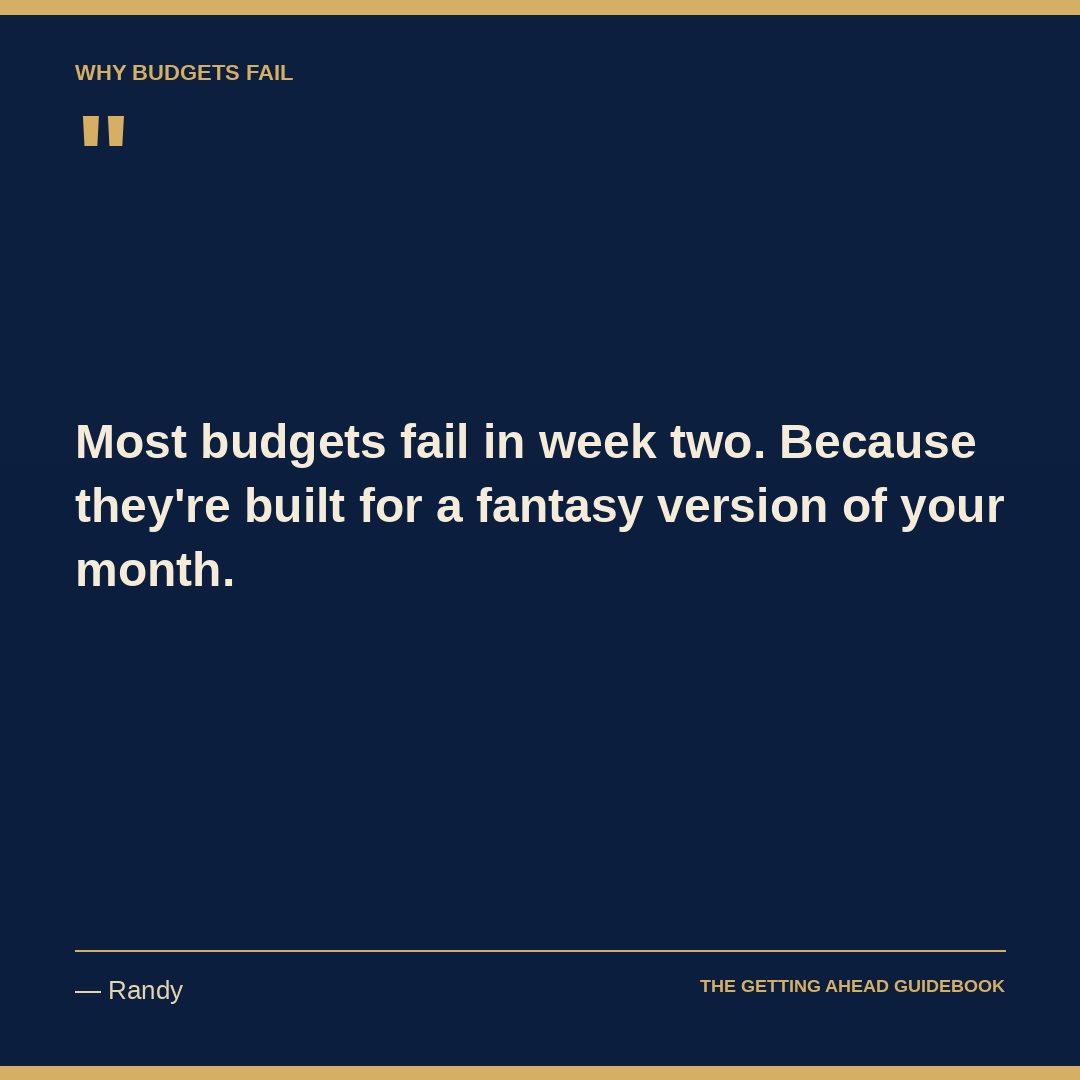
Most budgets fail in week two. Want to know why?
Because they’re built for a fantasy version of your month.
Real life isn’t tidy. Your nephew has a birthday. The dog needs the vet. Your spouse needs new work shoes. The lawnmower breaks. The kids want pizza on a Friday night because everyone’s exhausted.
A budget that has no room for any of that is going to collapse the first time something normal happens.
So here’s what we do instead in our system:
Necessities get a hard line. (Rent, utilities, insurance, debt.) These don’t negotiate.
Reserves get a hard line. (Christmas, taxes, car maintenance, vacation.) These don’t negotiate either — that money is already spoken for.
Then the rest of the money — what we call “variable expenses” — gets a single, generous category called “necessities” that absorbs all the everyday stuff. Pizza. Birthday cards. Vet bills. The lawnmower.
You don’t try to predict every single dollar. You give yourself a sane number to live inside, and stop when it’s gone.
That’s a budget that survives week two.
— Randy
Educational
Post 10 — The One Question to Ask
📍 Week 10 after launch
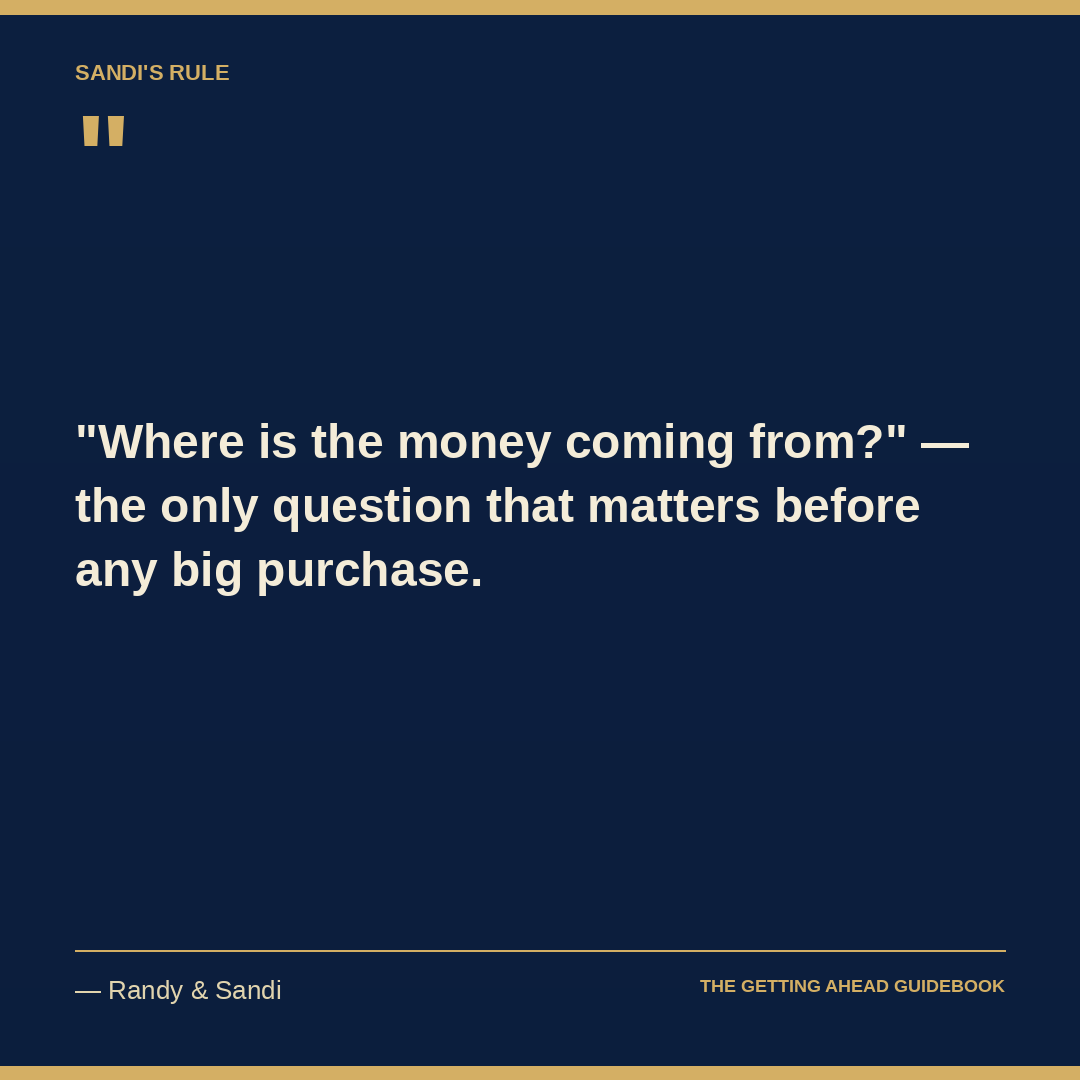
Before any major purchase — a car, a vacation, an appliance, anything over a few hundred dollars — Sandi and I ask one question:
“Where is the money coming from?”
Not “can we afford it?”
That question is too soft. The answer is almost always “yes, technically.”
But “where is the money coming from?” forces a specific answer. The vacation fund. The savings account. A reserve we set aside on purpose. Or — and this is the dangerous one — “we’ll figure it out.”
When the answer is “we’ll figure it out,” that’s the moment to slow down. That answer is how people end up with credit card balances that take years to pay off.
The big purchases aren’t what get you in trouble. The big purchases without a clear source of money are.
— Randy
Targeted
Post 11 — If You’re In Your 20s, Read This
📍 Tag-bait for grandparents to share
If you’re in your 20s, I’m going to tell you something nobody told me until I was almost 30.
The money habits you build right now — at 22, 25, 27 — will follow you for the rest of your life. Not because compound interest is magic (though it is). But because money habits become identity.
The person who pays themselves first at 25 will pay themselves first at 55.
The person who can’t see past Friday night at 22 will still be living payday to payday at 42.
The person who tracks where their money goes in their first apartment will know where it goes in their first house.
It’s not about how much you make. It’s not about whether you’re “good with money.” It’s about which version of yourself you’re rehearsing for every time you spend a dollar.
Be honest about it. You’re rehearsing for someone. Make sure it’s someone you’d want to be.
— Randy
P.S. — If you’ve got a 20-something in your life, share this with them. They’ll roll their eyes today. They’ll remember it in five years.
Seasonal
Post 12 — The January Surprise
📍 November/December warning, or January validation
January is the most expensive month of the year for most families.
Not December. January.
Here’s why:
December had Christmas. You spent more than usual. Some of it went on credit cards.
Then January hits, and suddenly:
– The Christmas credit card bill arrives
– Your homeowner’s insurance renews (most policies renew in January or July)
– Property taxes are due in many states
– Car insurance often hikes for the new year
– Maybe a registration sticker for your vehicle
– The kids need new shoes because they grew over winter break
– And the heating bill from December is the biggest one of the year
You walk into January feeling broke. Not because you can’t handle it — but because nobody warned you it was coming.
The fix isn’t earning more. The fix is knowing it’s coming and putting a little aside every month so January is just… another month.
That’s all this app does. It tells you what’s coming.
— Randy
Story
Post 13 — What Retirement Actually Looks Like
📍 Anytime — trust-builder
A lot of finance advice is written by people who haven’t actually retired yet.
I have. Sandi has. We’re living it.
And I’ll tell you what nobody tells you:
Retirement isn’t about how much you saved. It’s about how predictable your spending is.
If you know — really know — what your fixed costs are each month, retirement is calm. You can plan. You can take a trip when you want. You can help your kids. You can absorb a surprise.
If you don’t know what your fixed costs are, retirement is terrifying — no matter how big your nest egg is. Every unexpected expense feels like the beginning of the end. Every grocery bill feels reckless.
The folks I know who are enjoying retirement aren’t the ones who saved the most. They’re the ones who built simple money habits decades ago and are still using them today.
That’s the whole secret. You don’t have to be rich. You just have to be organized.
— Randy
Story
Post 14 — The Conversation Couples Avoid
📍 Emotional resonance with couples
Most couples don’t fight about money. They avoid it.
They avoid the conversation because it’s loaded. One partner spends more freely. The other tracks every dollar. One sees a shopping trip as fun. The other sees it as a stress signal. They’re both right, and they both feel misunderstood.
So they just… stop talking about it. Until something forces them to.
That’s the worst time to start the conversation.
Here’s what worked for Sandi and me, for what it’s worth:
We have a regular “money meeting.” Not a fight. Not a confrontation. A meeting. About 30 minutes, once a month, with coffee.
We look at the numbers together. We don’t blame. We don’t audit. We just look — and we make small adjustments for the next month.
You’d be amazed how much pressure leaves a marriage when both people are looking at the same numbers, at the same time, with the same goal.
The app makes those meetings easier. But the meeting itself? That’s the real magic.
— Randy
Educational
Post 15 — The Most Underrated Money Skill
📍 Contrarian education
You know what the most underrated money skill is?
It’s not budgeting. It’s not investing. It’s not finding deals.
It’s NOTICING.
Most people don’t actually know where their money goes. They think they do. They have a general sense. They could tell you “I spend a lot on groceries” or “we eat out too much” in broad strokes.
But the exact number? The dollars and cents that left the checking account last month, in writing, organized by category?
Almost nobody knows.
And here’s the thing — once you know, you don’t even have to TRY to change behavior. Just knowing changes everything.
The first time you write down what you actually spent on takeout last month, you’ll spend less the next month. You won’t make a rule. You won’t restrict yourself. You’ll just notice… and adjust.
That’s the entire job of a budget. Not to restrict. To NOTICE.
The rest takes care of itself.
— Randy
Opinion
Post 16 — What Your Subscription Pays For
📍 Honest pricing transparency
Let me be straight with you about our subscription.
The Getting Ahead Guidebook isn’t free. There’s a small monthly fee to use it. I want to explain why — because I think you should know exactly what you’re paying for.
You’re paying for:
✓ The servers that keep your data backed up, encrypted, and available on every device
✓ The developers who keep the app working as iPhones and Android phones update
✓ The email reminders that let you know when bills are coming
✓ Real human support when you have questions
You’re NOT paying for:
✗ Ads. We don’t have any.
✗ Data brokers. We don’t sell your information to anyone.
✗ “Premium tiers” that lock the important features behind a higher price.
✗ A marketing department. There isn’t one.
Every dollar you pay keeps the lights on and keeps this app honest. That’s it.
I’d rather charge a fair price and treat you like an adult than give it away for free and pay for it by selling pieces of you.
If that sounds reasonable to you, we’d be glad to have you.
— Randy
Story
Post 17 — Sandi’s Rule
📍 Light, shareable, funny
Sandi has a rule that’s saved us thousands of dollars over the years.
It’s called the “sleep on it” rule.
Any purchase over $100 — we sleep on it. We don’t decide that day. We don’t add it to the cart. We wait until tomorrow morning.
If we still want it in the morning, fine, we buy it.
You’d be amazed how often we wake up and realize… we didn’t actually need it. The urge to buy peaks at the moment we see something. Twelve hours later, the urge is gone.
Sometimes the best money move isn’t earning more or budgeting tighter. Sometimes it’s just sleeping on it.
— Randy
Educational
Post 18 — The One Page That Changed Everything
📍 Feature spotlight (forecast)
There’s one page in our budgeting system that, once we started using it, changed everything.
It’s not the dashboard. It’s not the budget itself. It’s not even the reserves.
It’s the cash-flow forecast.
For the first time, we could see what our checking account balance would look like — not just today — but next Tuesday. Next Friday. The morning of December 23rd.
Once you can see it, you stop guessing. You stop wondering if there’s “enough.” You know.
And once you know, you make better decisions. You schedule purchases on the right day. You see exactly when you’ll have room for that little splurge. You avoid the surprise overdraft.
It’s almost embarrassing how much peace one page of numbers can buy you.
— Randy
Story
Post 19 — What I’d Tell My Younger Self
📍 Reflective, multi-generational appeal
If I could sit down with the 25-year-old version of myself, this is what I’d tell him:
1. You don’t have to be rich to be at peace with money. You just have to be honest about where it goes.
2. The biggest expenses in your life aren’t the ones that hit every month. They’re the ones that hit every six months, every year. Plan for them.
3. Don’t try to predict every dollar. Just don’t be surprised by the predictable ones.
4. You’re going to make some bad money decisions. Forgive yourself. Then write them down so you don’t repeat them.
5. The right partner is worth more than any salary increase. (Hi, Sandi.)
6. Eventually you’ll figure out a system that works. When you do — write it down for everyone else.
That last one took me 40 years.
— Randy
Seasonal
Post 20 — The Tax Season Truth
📍 January-April or tax stress
Tax season is hell for most families. It doesn’t have to be.
Here’s why it hits so hard:
Most people treat their tax bill (or refund) as a surprise. Something that happens TO them. They wait until February to start gathering documents. They cross their fingers. They hope.
But your tax bill isn’t actually a surprise. You can roughly estimate it any time. And if you set aside a small amount every month — even just $50 or $100 — into a “Tax” reserve, April is just another month.
If you end up getting a refund, even better — you’ve now got an unexpected windfall sitting there.
But here’s the bigger insight:
A refund isn’t free money. It’s money you overpaid the government all year and they finally returned. If you’re getting a big refund every year, you might be having too much withheld from your paycheck. That money could have been working for YOU all year.
The point isn’t to chase refunds. The point is to stop being surprised.
— Randy